Introduction
Money has always existed in physical form — notes and coins issued by a central bank. Today, many countries are exploring ways to issue this same money digitally, creating what is known as a Central Bank Digital Currency (CBDC). In Jamaica, this digital currency is called Jam-Dex.
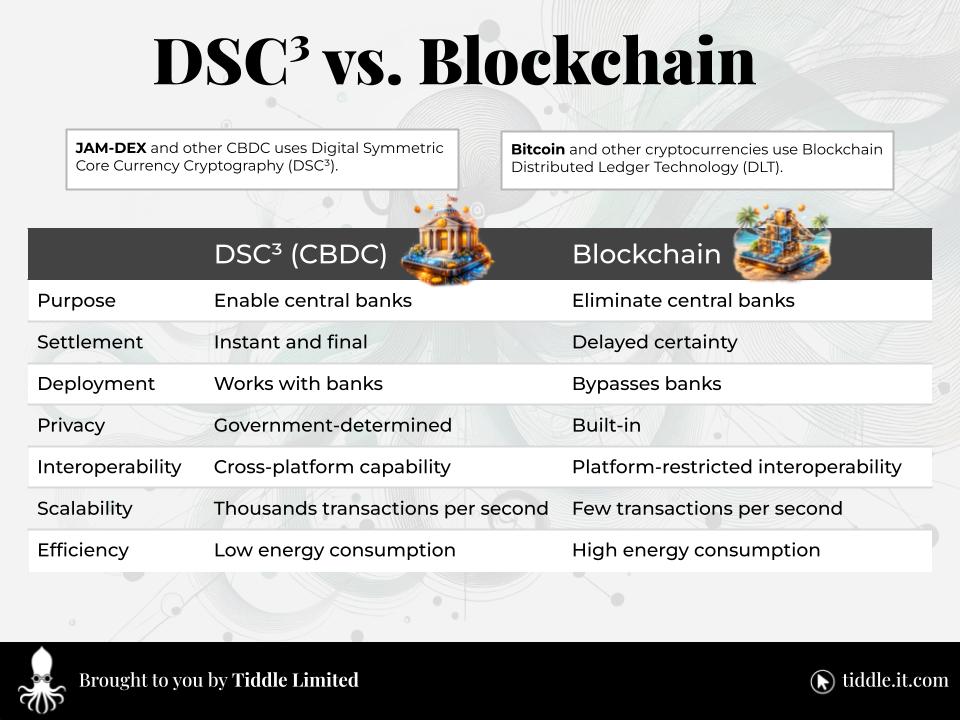
One technology developed for this purpose is Digital Symmetric Core Currency Cryptography (DSC³). It allows central banks to create a digital form of cash that can move between people just like physical money. This digital form of cash can be kept securely on our phones or computers and transferred directly from one person to another without the need for a bank account. In technical terms, this type of money behaves like a bearer instrument — similar to cash — where possession of the money represents ownership. An illustration later in this article will help compare how this type of digital money differs from Bitcoin.
Digital Money and the Question of Trust
In recent years, another type of digital money has gained attention — Bitcoin. Bitcoin was designed to operate without governments or banks. Its creator believed that money could exist in a “trustless” system, where mathematics and computer networks replace traditional institutions.
However, one important insight about money is that it has always depended on trust built over time. Governments, banking systems, and national currencies exist because societies gradually agreed to trust them. Merchants accept money because they believe others will accept it tomorrow. This shared belief — built through laws, institutions, and long social experience — is what gives money its usefulness.
This idea became clear to me while reading Easy Money, a book about the history of Bitcoin and cryptocurrency. As I explain in more detail in my article “Why This Bitcoin Book Didn’t Stick”, one key takeaway is that money cannot truly be “trustless,” because money itself is a product of trust formed through social consensus.
This raises an important question for new currencies like Bitcoin. If a currency is not issued or supported by a government, why should businesses trust it enough to accept it for goods and services? Without that broad social agreement, it becomes difficult for a new form of money to function smoothly in everyday economic life.