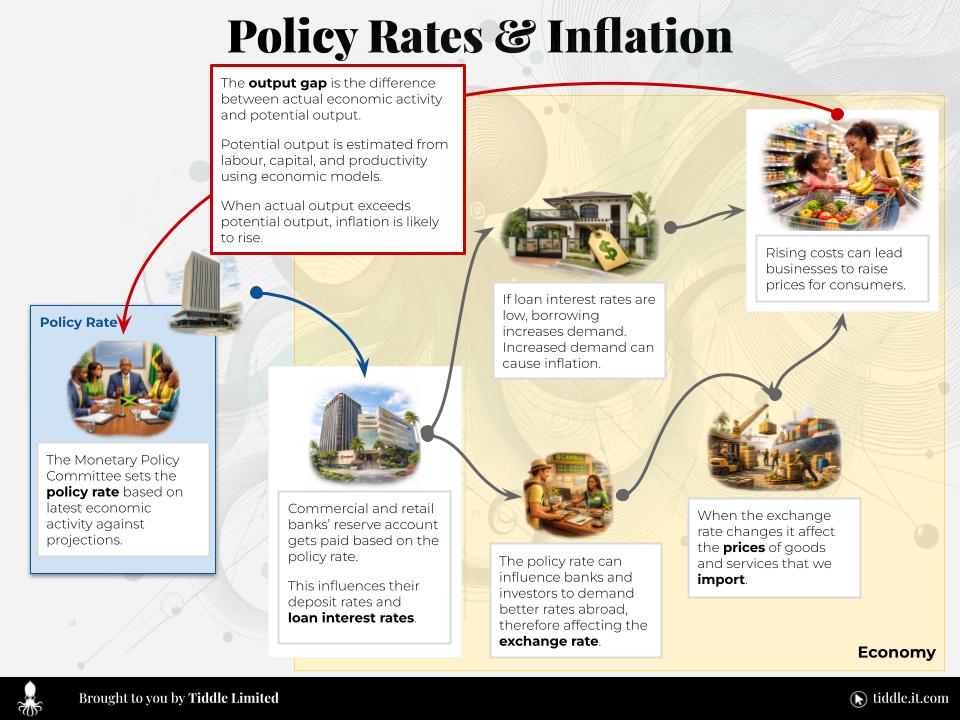

Jamaica targets an inflation range of 4% to 6%. This allows flexibility because the economy is highly exposed to external shocks, such as volatile oil prices, global economic changes, and weather events like hurricanes or droughts.
There are three main channels that the Bank of Jamaica uses to control inflation, as explained in Monetary Transmission Mechanism: the credit channel, the exchange rate channel and the inflation expectations channel.
The policy rate interest rate directly affects the credit channel and the exchange rate channel. Operationally, the policy rate is the interest the Bank of Jamaica pays on the reserve balances held by commercial banks; when this rate changes, it influences the lending rates banks set and therefore the amount of credit flowing through the economy.
Where the analysis begins
The process begins with sector analysis, where economists assess economic data from multiple sources.
The Statistical Institute of Jamaica (STATIN) provides inflation, GDP, labour statistics, and trade data. The Planning Institute of Jamaica (PIOJ) supplies information about sector performance, including tourism, agriculture, and manufacturing. Fiscal developments come from the Ministry of Finance, including government spending, taxation, and debt issuance.
The Bank of Jamaica itself contributes financial system data such as credit growth, banking liquidity, and foreign exchange activity. Analysts also examine global developments, including oil prices, foreign interest rates, and global economic conditions.
Turning data into forecasts
These inputs feed into the Bank’s Forecast and Policy Assessment System (FPAS). At the centre of this system is the Quarterly Projection Model (QPM), which simulates how inflation, economic growth, and the exchange rate may evolve over the next several years.
Because monetary policy affects inflation with a delay of four to eight quarters, the forecasts focus on where inflation is expected to be in the future.
Measuring Pressure in the Economy
Once the forecasts are produced, economists evaluate whether the economy is operating above or below its sustainable capacity.
To do this, they estimate Potential GDP—the level of production the economy can sustain when labour, capital, and technology are used at normal levels without generating excessive inflation.
Actual economic output is then compared with this benchmark. The difference between the two is known as the output gap:
Output Gap = Actual GDP − Potential GDP
If actual GDP rises above potential GDP, the economy is said to have a positive output gap. This indicates that demand is exceeding the economy’s productive capacity, which tends to generate upward pressure on prices.
If actual GDP falls below potential GDP, there is a negative output gap, meaning there is slack in the economy and inflation pressures tend to weaken.
By comparing actual economic activity with the economy’s productive capacity, economists can translate complex economic data into a clear signal about whether inflation is likely to rise or fall in the future.
The role of global interest rates
In a small open economy like Jamaica, domestic interest rates cannot be set in isolation. Banks and investors can place funds in foreign financial markets, particularly in U.S. dollar assets. For example, the U.S. Federal Reserve pays interest on reserve balances held by banks at the central bank, a key policy tool used to influence U.S. short-term interest rates.
If foreign interest rates rise significantly above Jamaican rates, capital may flow out of the domestic financial system toward higher-yielding foreign assets. Financial capital tends to move toward higher real returns, influencing exchange rates and domestic financial conditions.
For this reason, the BOJ must consider global interest rate conditions when determining its policy rate so that domestic assets remain sufficiently attractive and liquidity stays within the local financial system.
From forecasts to policy decisions
The resulting economic outlook is presented to the Monetary Policy Committee (MPC), which meets eight times each year.
If inflation is projected to exceed the 4–6% target range, the Bank may increase the policy rate to slow borrowing and spending. If inflation is expected to fall below target, the Bank may lower the rate to stimulate economic activity.
Through this continuous cycle of data → forecasts → policy decisions, the Bank of Jamaica adjusts interest rates to maintain stable prices while supporting sustainable economic growth.