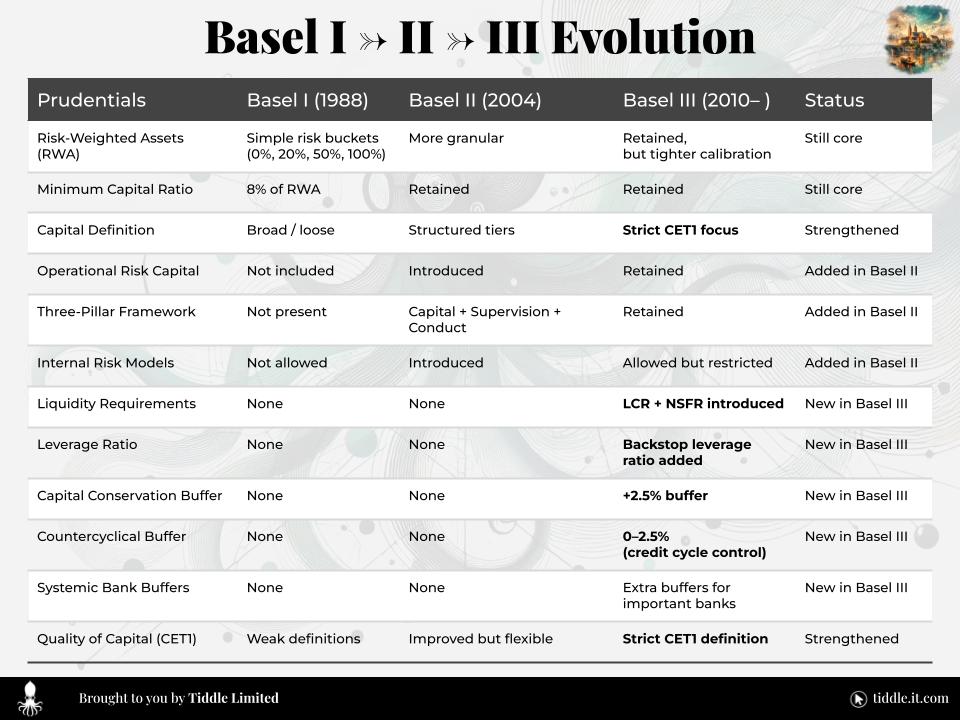

After the 2008 Global Financial Crisis, regulators saw a clear problem: many banks looked strong but were actually fragile.
They had:
- too little high-quality capital
- too much borrowing
- not enough liquidity
- funding structures that could collapse quickly
Basel III was created by the Basel Committee on Banking Supervision to fix this.
Global Adoption
Basel III is not a law. It is a global standard adopted by countries through their own regulators.
Today, most major jurisdictions—including the US, UK, EU, and many developing economies—apply Basel III–aligned rules, sometimes with local adjustments.
1. Capital — A Real Safety Cushion
Banks must hold strong, loss-absorbing capital.
Common Equity Tier 1 (CET1) Ratio:
CET1 Ratio = CET 1 Capital ÷ Risk-Weighted Assets
- Common Equity Tier 1 Capital: the bank’s own money—shares and retained earnings that absorb losses
- Risk-Weighted Assets: loans and investments adjusted based on how risky they are
Minimum:
- 4.5% + 2.5% buffer = 7%
This means: for every $100 of risk, the bank should have at least $7 of real capital.
2. Leverage — Limiting Excess Debt
Banks cannot rely too heavily on borrowed money.
Leverage Ratio:
Leverage Ratio = Tier 1 Capital ÷ Total Exposure
- Tier 1 Capital: core capital that can absorb losses (including common equity)
- Total Exposure: everything the bank is exposed to—loans, assets, and commitments—without adjusting for risk
Minimum:
- 3%
This means: for every $100 of total exposure, the bank should have at least $3 of capital.
3. Liquidity — Surviving Short-Term Stress
Banks must hold assets they can quickly convert to cash.
Liquidity Coverage Ratio (LCR):
LCR = HQLA ÷ 30-day Net Cash Outflows
- High Quality Liquid Assets (HQLA): cash or assets that can be quickly sold without losing value
- 30-day Net Cash Outflows: the cash the bank would likely need over 30 days in a crisis
Requirement:
- ≥ 100%
This means: the bank must have enough liquid assets to survive a month of stress.
4. Stable Funding — Long-Term Discipline
Banks must fund long-term assets with stable sources.
Net Stable Funding Ratio (NSFR):
NSFR = ASF ÷ RSF
- Available Stable Funding (ASF): reliable funding like equity and long-term deposits
- Required Stable Funding (RSF): the amount of stable funding needed based on the bank’s assets
Requirement:
- ≥ 100%
This means: stable funding must fully cover the bank’s long-term needs.
5. Capital Buffers — Preparing for the Cycle
Basel III adds extra protection tied to the credit cycle:
- Capital Conservation Buffer (2.5%)
- Countercyclical Buffer (0–2.5%)
These force banks to build capital in good times and use it in bad times.
Final Insight
Basel III is not just a set of formulas.
It is a system designed to control the credit cycle—to prevent banks from over-lending during booms and collapsing during downturns.
In simple terms:
Basel III exists to make banks strong enough to survive stress and stable enough not to cause it.